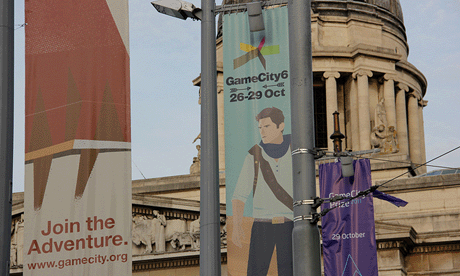
Twas an adventure in authenticity, a place where a genuine community of interest came together alongside inquisitive residents to share the realm of videogames and all that sails in her.
Over 4 days, the festival is the self styled “biggest and best-loved videogame culture festival in Europe!” and runs over multiple sites in the East Midlands city of Nottingham, during the day time, the night time and inbetween time (with the wonderful addition of Covernomics - a real life, real surveillance, covert mission piece of spy heaven). I wanted to share some of my experiences, some of the panels and debates attended, the people and developers I met and let this act as a guide to my experiences.
My first stop was a conversation between Richard Lemarchand, lead game designer on the forthcoming triple AAA PS3 exclusive, Uncharted 3 and Tale of Tales' founders Auriea Harvey and Michaël Samyn.

Hearing from Auriea and Michaël, who are a pair of Belgian art game developers and how they offered insights into their approach and creative journey from net art experimenters in the late 90s, to developing an impressive stable of alternative videogame experiences including: the fantastical MMO (minimal multiplayer online) The Endless Forest (an online environment where you appear as a deer, with no rules or goals to achieve), The Path (a short horror game inspired by Little Red Riding Hood offering an experience of exploration, discovery and introspection with all activities in the game entirely optional) and The Graveyard (a micro computer game where you play an old woman who visits a graveyard. You walk around, sit on a bench and listen to a song. It's more like an explorable painting, but there’s a huge difference between the paid version and free version of the game).

Richard also offered an insight into how a certain scene in Uncharted 2 was inspired by Tale of Tales and it was a section where the lead character Nathan Drake came across a small mountain village with a community and the game did not let you shoot or attack its population, in fact if you pressed the attack button, it made you shake hands or wave at the village members. Richard was trying to build this narrative and emotional connection between the lead character of Drake and the villagers because later on it the game (spoiler alert) the village gets burnt down.
Auriea and Michaël were fascinating, charming and achingly articulate throughout and with their creations offer a genuine alternative to the big time computer game behemoths which I’d heartily recommend that you engage with. Head over to Tale of Tales to find out more.
Later in the evening, we experienced Renga from Wall Four, which was the world’s first 100 player laser-controlled video game. It combined strategic conquest elements from games such as Civilisation with action phases inspired by old-school arcade classics such as Defender. It rewarded coordinated movement but allowed formations to emerge without advance planning as players observe other lasers and join emergent groups, sort of like an improvisational dance. As a collective experience, it was exhilarating, something akin to the feeling at a sports stadium when the crowd become one, we were a hive, a pack all working the greater good. A totally unique experience.
The next day was all about the Zombies, one of the large successes of Game City 6 and previous incarnations is that they often theme days and today was all about those beloved half –dead henry’s.
Each day began with a breakfast debate at the wonderful Broadway Cinema chaired by the Guardian Games’s Keith Stuart, today was: Love, Rage and Horror – are games emotional enough? There was a stellar panel including Simon Parkin (Eurogamer), Phil Fish (Fez Dez Rez), Richard LeMarchand (Naughty Dog), Mike Bithell (Thomas Was Alone), Andrew Smith (Spilt Milk Studios) and Rob Yescombe (formerly Free Radical and Crytek).
Richard offered us “games elicit certain kinds of emotions, competitive games elicit triumph, success and frustration”, and Phil replied with “Silent Hill 1&2 are the finest piece of horror on any media and we worked with fear specialists who said turning left down corridors is scary and different ceiling heights in different rooms is also scary”. The next topic was sadness with the videogame Heavy Rain appearing heavily and Keith cited the greatest fear if you’re a parent is the loss of your child and that was why Heavy Rain was so successful, Simon replied us “games are great at revenge stories, but not redemption”. Finally the 7 men on the panel spoke about love with The Sims and Ico leading the discussion. Simon “The Sims tries to mechanise love in a dry way, it’s an economy. Whereas in Ico, you have to lead this small waif through different lands and you have to look after her or she’ll be sacrificed.” Keith shared: “if you come to a standstill after you’ve run around with her, you can feel her heartbeat through the controller”. The debates were genuinely interesting, covered a range of topics and brought us insight from a diversity of panellists who wouldn’t normally talk about these sorts of things.

Later in the day there was a Scare Tactics panel with James Moran (Severance and Doctor Who), Gerard Jones (DC, Marvel, Dark Horse) and Rob Yescombe again. James and Gerard provided great content and bounced off each other really well. Gerard spoke about “how cat scares (the quick startle) are not really interesting and a good scare for adults is based on suspense, anxiety and something being unsettled”. James offered us a piece of classic Hitchcock “where it’s scarier to show a bomb and then create a 10min scene about what might happen rather than show the bomb explode.” He also mentioned the film Threads (a documentary-style account of a nuclear war and its effects on the city of Sheffield) as being quite scary as well. Gerard also said that “what’s scary to a 3 or 4 year old child is adult scowling face looking scary. Suspense is unbearable to young children, kids can watch heads being chopped off, but being glared at is really scary.” For me there was a significant amount of information which was being recycled by Rob who was re-telling horror content from his previous session and the breakfast earlier on in the day. I feel that this should have considered by Game City or it may be that Rob doesn’t have a lot to say.

My final encounter with the zombies, apart from the fabulously made up green shirted volunteers around the city square, was an insight into the funding, conception and development of a hotly anticipated running game and audio adventure called Zombies, Run! created by Six to Start. It will be available on your iphone and smartphone by the middle of next year and I know it’s going to get a lot more people active and exercising who might not have gone for a run before, but now they’re running from zombies, collecting items and building your base back at HQ, a genius idea!
My final musings are linked to encounters which I was actively involved in; Covernomics and Several Amazing Things About Tetris (1984).
SATAT 1984 was a seven hour performance lecture all about the mid 80s tetronomic gaming masterpiece Tetris. However, this lecture by Pat Ashe lasted as long as you stayed alive in the game and the blocks didn’t fill the screen. A brilliant concept, fascinating factoids learnt and a charming performer. PS I’m sure I also got the highest score of the day. From Russia With Fun!
Covernomics was another durational experience but this time over 4 days. Through email, phone calls and illegal rendezvous it instructed you to go undercover, decipher codes, assemble electronic devices, accrue assets and survey other agents in the field whilst avoiding detection. Agents were assigned daily tasks (I’m not revealing too much detail as they want to return next year) and I’m pleased to report that I completed Operation GC6 and was one of the top ten of agents.
For me, Game City 6 captured the true spirit of a festival with oodles of positivity oozing from the staff, volunteer teams and exhibitors which in turn infected us, the participants to be generous, encouraging and enter into the essence of debate and inquiry which the festival fostered so well. I only encountered a small percentage of the festival, but what I experience I was left sated and elated and will no doubt return to future iterations of the wonderful and valuable experience that is Game City.
Images courtesy of Game City, Tale of Tales, Nintendo, Six to Start
 As a 16 bit call to arms, it doesn’t get any bigger than
this. In a world where beans need help, I was called on to thwart Dr Robotnik
and his evil henchbots as innocent beans were rounded up to be hurled into the nasty
mean bean steaming machine. This hellish creation would turn the jolly folk of
Beanville into devious bot beans rendering them lifeless and at the same time sucking
out all the music and fun in the world.
As a 16 bit call to arms, it doesn’t get any bigger than
this. In a world where beans need help, I was called on to thwart Dr Robotnik
and his evil henchbots as innocent beans were rounded up to be hurled into the nasty
mean bean steaming machine. This hellish creation would turn the jolly folk of
Beanville into devious bot beans rendering them lifeless and at the same time sucking
out all the music and fun in the world. The soundtrack and audio design is a splendid sonic glove that
fits this classic puzzler so well. With metallic 16 bit rasps combining with pulsing
frentic drops and the joyous “yippee” high as I cleared a chain reaction of quatro
beans. The intelligent audio design certainly helped quicken my heart as beans stacked
high and with just three clear rows remaining, the bpm increases, the pace
ramps up and if concentration is not kept then death had a habit of becoming
me.
The soundtrack and audio design is a splendid sonic glove that
fits this classic puzzler so well. With metallic 16 bit rasps combining with pulsing
frentic drops and the joyous “yippee” high as I cleared a chain reaction of quatro
beans. The intelligent audio design certainly helped quicken my heart as beans stacked
high and with just three clear rows remaining, the bpm increases, the pace
ramps up and if concentration is not kept then death had a habit of becoming
me.